This is a work of fiction. While it draws on real historical events, public figures, and interviews conducted by the author, the personal characters and their stories are products of the author’s imagination.
Running time
90 minutes + 10-minute intermission
Content Warnings
This show includes mature language, sexual content, depictions of gun violence, brief depiction of state brutality, and war. It also features strobe lighting and other rapid light effects, which may pose a risk to individuals with photosensitive epilepsy or other light sensitivities.
For more specific content warnings, see here.
Land Acknowledgment
We sit on the ancestral land of the Muwekma Ohlone Nation. We recognize that the members of the Bay Area community have, and continue to benefit from, the use and occupation of this land, which was and still is of great significance to the Muwekma nation.
The Muwekma Ohlone nation has been seeking federal recognition for decades, but they continue to face significant obstacles including general indifference, police brutality, and unfair press reporting. We encourage you to support the Muwekma Ohlone’s fight for national recognition at muwekma.org, pay Shumi land tax at sogoreate-landtrust.org and locally, advocate for a free education for Indigenous students.
Directors’ Notes
“A sinuous genealogy” by César Valenzuela
The genealogy of Twinks in Caracas: An Oil Fantasia is as sinuous as the structure of the show itself. The first scenes emerged during the 2025 Solo Performance workshop hosted by Crowded Fire in San Francisco, where we discussed Anna Deavere Smith’s Notes from the Field. Smith’s ability to portray a dire sociopolitical reality while giving voice to those at the center of injustice inspired me to dip my toes into documentary theater for the first time.
Those early drafts shared something in common: they dealt with my experience as a Venezuelan immigrant in an unreal, dreamlike way. This led me back to Charlotte Beradt’s The Third Reich of Dreams, which documented dreams of German citizens during the Nazi era—and the core idea of the show was born. I interviewed a small group of Venezuelan immigrants in the U.S. about the dreams they had been having in recent months. The interviews were anonymous, and they were among the most enriching parts of this creative process.
The title, the queerness, and the drag were inspired by one of the most influential works of art in my life: Angels in America. More specifically, drag helped me articulate the split between realities within the world of the play. Antonio’s drag persona, “Miss Comandante,” satirizes the dictator Hugo Chávez, while also serving as the vessel of Antonio’s unconscious—the channel through which the collected dreams are presented on stage.
One final source, from many years ago, was Reinaldo Arenas’ autobiography, which he ended with a suicide note blaming a single culprit for his demise: Fidel Castro. The power of Arenas’ words lay not in the accuracy of that claim, but in a political truth: by usurping the sovereignty of the Cuban people, the Cuban Revolution destroyed the lives of all its citizens. I believe that Hugo Chávez, as mastermind and leader of the Bolivarian Revolution, bears an equivalent responsibility in Venezuela. Twinks in Caracas aims to illuminate the horrendous legacy of the “Comandante.”
This show is dedicated to the 28 million Venezuelans whose country has been held hostage by the Bolivarian Revolution for 27 years. They may have pushed us out and subjected those who remained to a brutal regime and a shattered economy. But they have never taken away our hope, or our will to keep building our lives wherever we are. May we all see the end of this tragedy soon.
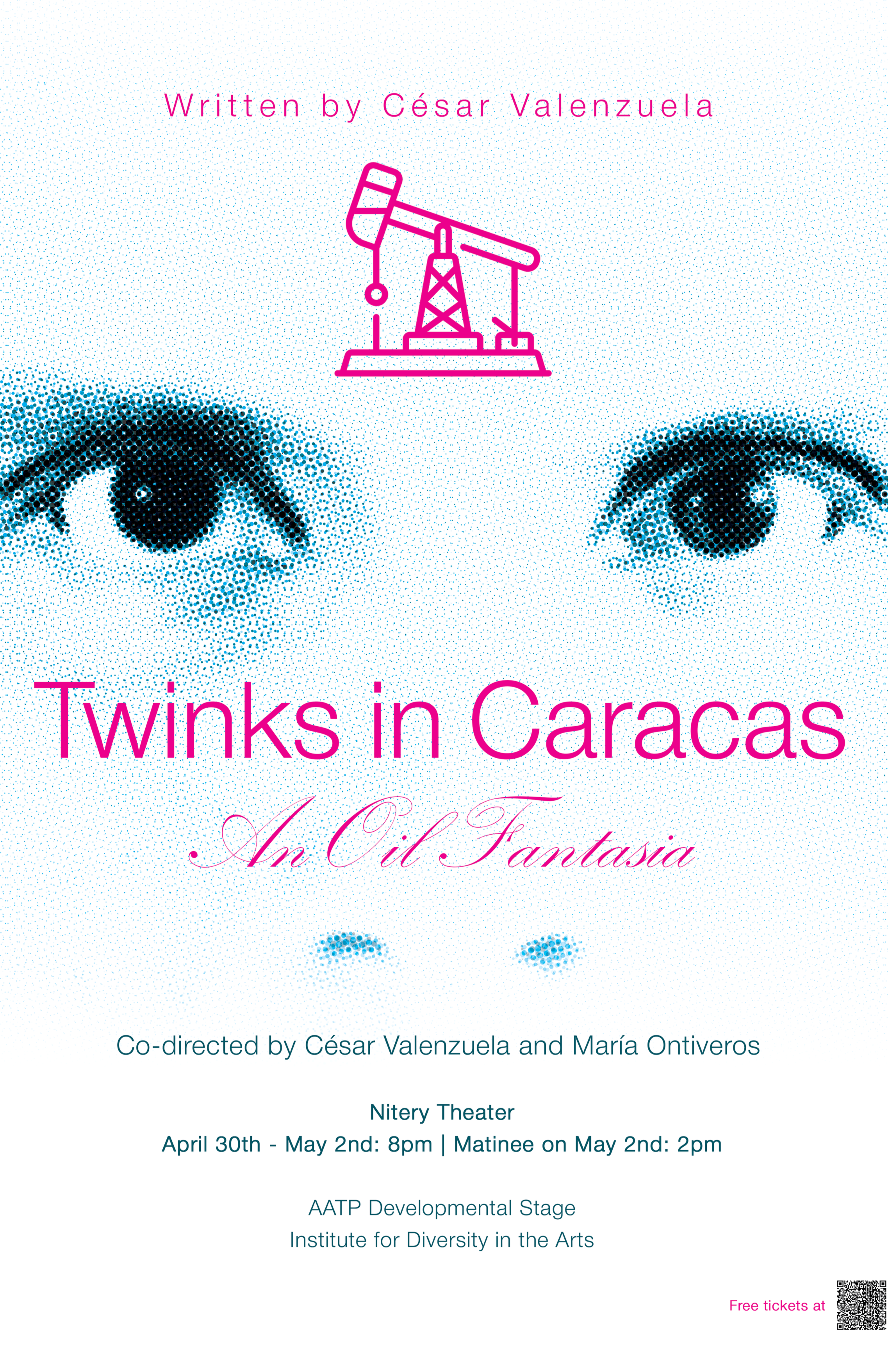
I want to thank our small but mighty team. My co-director María, whose deep understanding of the project’s artistic and personal intentions brought the play to places I hadn’t imagined—and whose support made an emotionally taxing process bearable. Our producer Angela, a force of nature and an incredible collaborator who brought joy, momentum, and made the show materially possible. Our lighting designer Trini, an immensely talented human who transforms complex emotions and the most intricate aesthetic ideas into magic on stage—she ensured the show reached the oneiric dimension where it unfolds. Our set designer Jonathon, who enthusiastically embraced our wildest ideas and used his craft to create exactly the environment we envisioned. Our make-up artist Génesis, whose amazing talent (and pedagogical skills!) brought the show deep into the drag world. And our graphic designer and my dearest friend Hibert, who captured the show’s entire aesthetic in a single image. Hibert, perhaps more than anyone, understands the personal depth of this project. If friendship has a name, it’s Hibert.
Finally, my deepest thanks to the Venezuelans who shared their dreams and migratory experiences with me. Thank you for your trust. You are all deeply inspiring, and I hope this show does justice to the complexity of your stories.
“Questions and Dreams” by María Zurita Ontiveros
When César told me they were writing a play about the dreams of Venezuelan immigrants, I thought they meant the figurative use of dreams–I dream of a stable job, I dream of a happy family, I dream of an end to war. When they mentioned literal, in-bed-at-night dreams, the idea of this play came alive for me. Dreams, beyond the figurative hope they often signify, are complicated. We find ourselves in familiar places that now feel strange, or recognize new places as deeply familiar. We find ourselves closely relating to people we’ve never met, or in conflict with people we love. We often struggle to put dreams into words, reaching for vague phrases that don’t quite capture the vividness of the experience.
Oddly, this is also how this year has felt for me. The place I’ve called home for many years now has me on edge. My reality feels familiar, yet new. With recent events, I too find myself in conflict with loved ones over what is right. I struggle to put my experience into words as I reach for vague phrases like “recent events” because more specific language may put me and others I love at risk.
What I am describing sounds more nightmarish than dreamlike, I admit, but the core element of hope that distinguishes the two for me is the people around me. People who are risking so much in calling for peace. Friends getting married and starting families despite fear of separation. Family members calling with a “did you get home safe?” or a “you’ve been on my mind recently.” And lately, the dedicated work by the people in this production. César, writing this play, and all the interviewees trusting us with something as intimate as their dreams.
When social media and the news push us to think in binary ways, this play asks us to consider nuance. This play makes a space to talk about the reality of many Venezuelans at home and in the diaspora beyond looking for political affiliations. It asks us, how can we push for what is right without normalizing violence along the way? How do we reckon with promises of freedom and democracy that never came? What is the role of art in times of war?
Is this numbing the wounds, or treating them?
I don’t have answers to these questions, but I am happy to finally be sharing them with you.
Staff
Co-directors
César Valenzuela
&
María Zurita Ontiveros
Playwright and Performer
César Valenzuela
Producer
Angela Vincent
Dramaturg
María Zurita Ontiveros
Set Designer and Technical Director Jonathon Howell
Lighting Designer
Trini Rogando
Video and Sound Designer
César Valenzuela
Costume Designer
César Valenzuela
Assistant Costume Designers
Angela Vincent
María Zurita Ontiveros
Make-up Artist
Génesis Montilva
Graphic Designer
Hibert Castillo
Stage Manager
María Zurita Ontiveros
Props Manager
Angela Vincent
Acknowledgments
Twinks in Caracas: An Oil Fantasia is a developmental stage production for the Asian American Theater Project (AATP) and was made possible through the support of AATP and the Institute for Diversity in the Arts.
Special thanks to the participants of the 2025 Solo Performance workshop at Crowded Fire, the Nitery Theater, the TAPS department, Anna Deavere Smith and the participants of her 2026 TAPS workshop, Pauline Mornet, the fellows and residents of the Institute for Diversity in the Arts, the participants of the CBPA Artists Circle, Eric García, Xinyuan Pu, Bailey Scieszka, Jacqueline Harding, Lis Benossi, Ret Glasgow, Caitlin Brust, Malinalli Díaz, the Stanford Humanities Center, and the Stanford Shakespeare Company for their support and feedback throughout the conception, creation, and production of this show.
Specific Content Warnings
This shows also includes depictions of a dog attack, violence against animals, bombings, descriptions of kidnapping and torture, abusive relationship, threats of deportation, depiction of authoritarian rule, and homophobic hate speech.